Showing posts with label BLOCKS OF THE MONTH. Show all posts

Monday, February 27, 2012

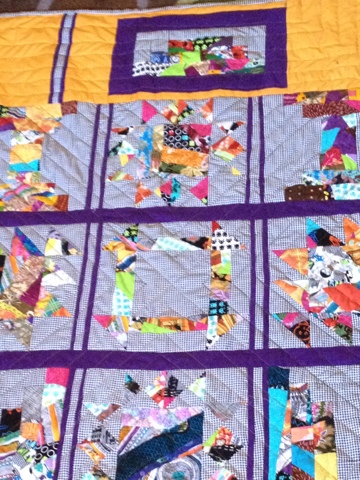
My BOM is complete

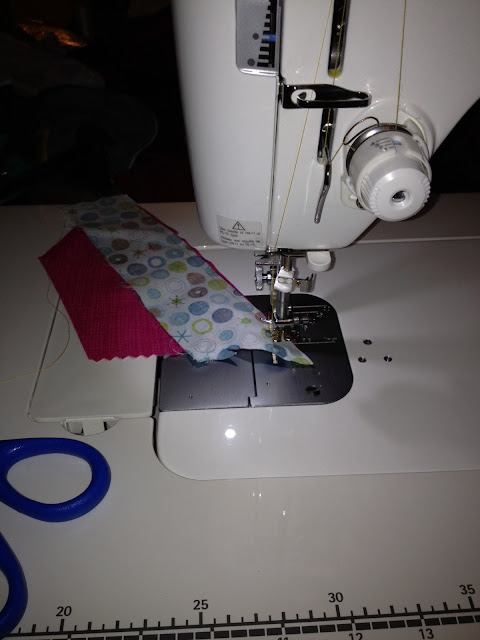
Whew... I actually completed the BOM challenge quilt. I am surprised, for I imagine it would not happen since the top was sufficient. I enjoyed my machine quilting. I used the walking foot for this and made my binding. All done.


Friday, December 30, 2011

BOM's Everywhere...I finally started mine...

Hi everyone, its the end of the year...and it seems like so long ago that I posted the tutorial for the Courthouse Block.  Anyway with a bit of fabric inspiration, and an evening of 15 minutes plus...I started making some of the Blocks from the tutorial...I hope to try about 5 or 6 of them, by the time I'm done.

I actually did a Queen V (bumblebeans), I cut up absolutely lovely fabric into pieces and mixed them in with some scraps.  Oh what an exhilerating feeling...

So here are some pics from start to finish...a little more than 15 minutes.  More like 2 1/2 hours.


Pile of Fun.


The first Stitch

Voila...I spared you the cutting pic...smiles

Tuesday, September 13, 2011

Blocks of the Month- All Caught Up!


I finally caught up on my blocks of the month! These have been a lot of fun because I was collecting fabric for a black & white quilt for quite a while but was never moved to make it. Now I have great blocks for a better, more colorful black & white quilt!

Thursday, August 25, 2011

More Blocks of the Month

I just moved, but I set up an ad hoc sewing area so I could get to sewing right away! I'm trying to catch up on my blocks of the month, and still have quite a few more to make. Here's my most recent additions:

Cactus Flower


Hybrid Tea Rose


My BOM's to date

I am very excited to finally have space for a design wall in my new home. Do you have any recommendations for an easy and inexpensive way to set one up? Thanks gals!


Wednesday, August 10, 2011

Victoria's Basket of Flowers


I finally got some time to sit down and make some fabric.  The first block on my list was Victoria's Basket of flowers.  I really like how the tutorial made is so easy.


Here are all the blocks I have made so far.  I'm really liking how these are turning out.

I think I will make the basket of flowers for the BASIC QUILT.  It will look nice done with a green background and brights.

Hugs to all, Cathy

Wednesday, August 3, 2011

Seesaw Block Tutorial

Remember playing on the seesaw with your best friend? This isn't quite as easy but should be just as much fun. I strongly recommend you read through the tutorial all the way first - there's a picture of the finished block toward the end. It will probably sound way more intimidating than it really is. The trickiest bit is making sure your diagonal lines are headed the right direction.

For this block you'll need a piece (or pieces) of made fabric from which you can cut four rectangles, 3.5" x 6.5" and four 3.5" squares. You will also need four rectangles of background fabric, also 3.5" x 6.5" and eight 3.5" squares.
We're going to begin by making four flying geese units using the four made rectangles and the eight background squares.


Lay one of your background squares on top of one end of a made rectangle, right sides together. If you like you can draw a diagonal line on the back of your square patches, connecting opposite corners as you see below.


I prefer to skip that step. Instead I lay my 6" ruler on top of the stacked patches with the 1/4" line of my ruler falling through those two corners.

When I have double-checked the position of my ruler I make the cut.


That leaves me with a raw edge exactly 1/4" away from where I want the seam to be.


Put it in your sewing machine as you normally would when piecing. I happen to have a quarter inch foot on my machine. You can see here that I'm sewing right on that line I'd drawn.


I chain piece the four rectangles and then run a pair of the off cut triangles through to free the rectangles from the machine. Once they've been pressed you should have this:


Now we need to do the other end of the rectangles to make our flying geese. Lay one of your background squares, right side down, on the other end of each of your made rectangles.


You'll use the same process as you did for the first half of these units. Draw your diagonal line or lay your ruler on the patch with the 1/4" line running through the corners. To get this line going the right direction - so I end up with a flying goose in stead of a parallelogram! - I turn the whole thing around. Essentially I'm working now with the top of the goose at the bottom of the picture.

So I will be cutting along the right edge of the ruler as you're looking at the picture above. Once I've made my cut, sewn the seam, pressed the background out, and have done the same for the other three units, I have four flying geese units:


Now we're going to use the same technique to put a made-fabric triangle on the end of the background rectangles.


I laid a made-fabric square on top of each background rectangle, pulling back the corner of the made fabric and turning the made fabric patch until I'm happy with what will be left after I cut off the extra. This is also a good time to make sure you're headed in the right direction with your line/ cut. In this case we will be making four identical units with the made fabric in the upper left corner of the finished rectangle.

Again, in order to accomplish that I have to turn the patches around so that I'm working from the top of the unit. This time you will be laying the ruler on the back of your made fabric. Cut off the corner, sew the seam, and press the rectangle out. (Or draw a line, sew the seam, trim off the excess, and then press.) Then do the same with the other three rectangles.


You should have four units that look like this:


Now you'll pair up your flying geese units with the rectangles. Sew them together along that long horizontal edge at the bottom of the goose.


You should have four of these when you're done.


Rearrange the four quarters so each goose is pointing in a different direction, right around the compass points:

Sew these together the way you would any other four patch block and you'll have your finished Seesaw block!

I sent my off cut triangles through the sewing machine whenever I needed to take a set of chain pieced units off for pressing.


You should have 12 of these little half-square triangle units to play with. They can be the beginning of a sawtooth border or used in other, smaller, blocks. Here I've arranged four into a Broken Dishes block and another four into a Pinwheel block.


I hope you'll give this a try. Cutting and sewing through all those seams in your made fabric can be a challenge but it's worth the effort. The one thing I've learned is it's more effective to keep the scraps in your made fabric relatively close in color or value and then pick a background fabric with really good contrast to your made fabric. The most important thing? Remember to breathe, and HAVE FUN!

Magpie Sue

Tuesday, July 19, 2011

Catching up with Courthouse Steps

I have barely gotten a chance to sew this summer- but I carved out a few minutes today to start getting caught up on the Blocks of the Month. I thought it would be fun to accentuate the structure of this block with stripes!

Friday, July 15, 2011

BOM: Churn Dash Slash


For this block of the month, we're going to take a classic quilt block, the churn dash, and pizazz it up with made and slashed fabric. This tutorial will make 2-12 1/2" blocks with the effect that the churn dash shapes were cut from each other and are floating on top of the background. This would be a great block for using a large or directional print for the background/contrast fabric.

First- make fabric!

1. Start by sewing a 14-15" square of made fabric. Add a slash or two- it will look best if your slash goes somewhere near the middle of the block. Trim to 14 1/2".


Cutting

1. Cut a 14 1/2" square of contrast fabric.


2. Now, cut each square into an uneven 9-patch by slicing a 4" strip off of each side, making sure to keep the pieces in place. You will have:
1- 6/12" center square
4- 4" x 4" squares
4- 4" x 6 1/2" rectangles


3. Next, cut each 4" x 6 1/2" rectangle in 2 the long way, again making sure to keep track of each piece's position in the 9-patch. You will have 8-2" x 6 1/2" rectangles for each block.


4. Finally, cut each corner square on the diagonal. Make sure to cut the diagonals framing the center square for the made fabric, and also if you are using a large or directional print for your contrasting fabric.


Arrange the Pieces

1. Start to switch out the pieces closest to inner circle, making sure to swap for the piece in the same position form the other block to get the effect that the contrast churn dash is floating on top of you made fabric and vice versa.


2. The two churn dashes emerge once you switch out all the pieces.


Sewing

1. Sew the corner triangles with a scant 1/4" seam to make half-square triangles. Trim to 3 1/2" square.


2. Sew the rectangles together along the long side. Usually I chain piece and throw it all together, but for this block, I pinned, and sewed one pair at a time so I could keep all the pieces aligned.

You will have 4 3 1/2" x 6 1/2" rectangles. Remember to keep them in their places!


3. Press the rectangles and half-square triangles open with the seams towards the contrast fabric. When you lay out your block, you will have:
1- 6 1/2" center square
4- 3 1/2" corner half-square triangles
4- 3 1/2" x 6 1/2" rectangles


4. Now sew the side pieces onto the center pieces.


5. Press with the seams of the center section towards the contrast fabric. Press the seams of the top and bottom section in the opposite direction.


5. Sew the top and bottom onto the middle section.


6. Press the seams toward the contrast fabric.


Ta-daa! Your block is done!


Now go back and repeat the sewing steps for the reverse block.

Enjoy!